

Blog Categories
Web design Branding Blogging Social Media Inbound All
We post weekly tips, tricks, and marketing advice to help grow your business.

How do I increase organic traffic to my website?
Your mom is going to visit your website. Your dog would definitely visit your website if he could use the computer. Strangers though? They need a reason to come visit your website. Wanting more organic traffic is pretty much a common theme amongst website owners. So how do you achieve that?

Your mom is going to visit your website. Your dog would definitely visit your website if he could use the computer. Strangers though? They need a reason to come visit your website. Wanting more organic traffic is pretty much a common theme amongst website owners. So how do you achieve that?
1. Make sure you have a specific goal for your website.
Do you want to book more appointments? Grow your list of subscribers? Sell your product? Pick one goal and design your website around it. The main navigation and any CTAs you use should all work toward achieving that goal. For example, if your goal is to book more appointments then you darn well better have several Book Now buttons on your homepage!
Designing a website without a plan is like trying to bake without using a recipe. Throwing a bunch of ingredients haphazardly into a bowl simply won’t work. That said, the first ingredient on every website recipe needs to be a clearly defined goal.

Goals to consider:
Book more appointments
Grow my email list
Sell my product or service online
Drive more foot traffic to my store
2. Know your target audience like the back of your hand.
Once you have the goal of your website locked down, next comes the heavy lifting. It’s a step in the design process that many people wish they could skip … persona research.
“A buyer persona is a research-based profile that depicts a target customer. Buyer personas describe who your ideal customers are, what their days are like, the challenges they face and how they make decisions.”
Researching and building your buyer persona(s) is a critical step of the website design process. Once you know exactly who it is you want visiting your website, you’ll have a much better handle on what it takes to get and keep them there. Your website needs to be a happy place for your target buyer persona. The messaging should speak to them in a language and style they can relate to. The content you provide should be very valuable to them.
“First, show your potential customers that you get them by addressing their pain or need - only then, will they be open to exploring what you have to offer.”
Another plus to fleshing out your buyer persona(s) is you’ll gain insight on where and how they seek information. Are there certain blogs they subscribe to? What websites do they go to for information? Are there specific keywords they’re using in Google searches? Knowing where your buyer persona is hanging out online makes it much easier to get your website in front of them.
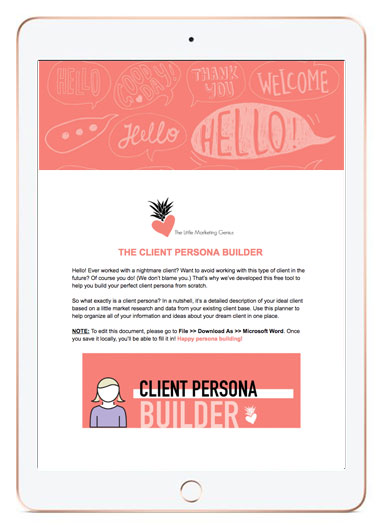
CREATE THE PROFILE OF YOUR DREAM CLIENT USING OUR FREE CLIENT PERSONA BUILDER!
Once you know exactly what your dream client looks like, you’ll never make the mistake of taking on (or marketing to) a nightmare client again. Download our FREE Client Persona Builder tool today.
3. Perform keyword research.
If you want your website to have a chance of ranking in Google search results, then you need to do a little keyword research. Researching ideas for keywords is not rocket science either! You can get ideas from current customers or clients by simply asking them how they’d search for topics related to your business on Google.
You can also perform a little brainstorming session of your own. Open up a blank Word or Google doc and start typing as many search words or phrases you can think of as it relates to your business. After you have your list, start plugging your ideas into the Google search box. When you do this, you’ll notice at the bottom of the results page there is a list of other related searches. Add these to your list as well.
With your keywords plotted out, you can now craft your copywriting for SEO!
Read HubSpot’s Tips for Keyword Optimizing the Most Critical Parts of Your Website

4. Start blogging.
Blogging is a great way to get your small business found on Google. Each time you publish a new blog post, you’re adding a new page to your website that will eventually be indexed. This equates to more opportunities for you to show up in search results!
Your blog should provide value to your target buyer persona by answering their questions and offering up solutions. It should be educational … not sales-y.
A blog is the perfect way to showcase and share your industry knowledge with your audience. When you develop interesting and informative content based on your own expertise and experience it not only positions you as a thought leader, but also creates a fantastic opportunity to share something with your social networks.
Pro Tip! Consider guest blogging on a blog that your buyer personas like to frequent!
Download our free step-by-step guide to blogging!
Implement these four strategies and watch as organic traffic to your website begins to increase. Remember, content is king. Keep those visitors wanting to come back for more!


Tuesday Tip #11: How To Use The Customer Value Journey To Grow Your Small Business
Plotting out and understanding the Customer Value Journey can lead to big wins for your small business. For today’s Tuesday Tip, I’ll explain what the journey is all about and then provide you with some direction on putting it to work for your business.

Plotting out and understanding the Customer Value Journey can lead to big wins for your small business. For today’s Tuesday Tip, I’ll explain what the journey is all about and then provide you with some direction on putting it to work for your business.
First thing’s first. What exactly is the Customer Value Journey? Well, the idea behind it is actually common sense. I love the way our friends at IMPACT put it so I’ll share a quote from their blog:
“Just like it would be highly inappropriate to say hello to new acquaintances by touching their hair, you can’t assault your prospects with heavy sales pitches right off the bat. That’s why you need to make people feel comfortable around you (or your brand) before they’re ready to move to the next stage (in this case, making a purchase.)”
The goal of the value journey is to “build a universal framework for transforming strangers not just into customers, but into rabid buyers and raving super-fans.” (IMPACT)
Sounds great, right? So now let’s dive into the different stages of this journey and how you can be optimizing each one.
1. Aware
This is when a prospect realizes their need for something you can provide them with and discovers, or becomes aware of, your brand. They might have found you by means of a referral, on social media, or an online search.

I’m going to illustrate with a real-life example.
When I moved out to the country in 2017, I experienced a bit of a culture shock (that’s putting it very mildly). I had been previously accustomed to driving very short distances to get to the places I needed to go. The mall being one of these places. Fear immediately set in over how this move would impact my wardrobe.
One day, I was hanging out with my sister-in-law (who just so happens to also live in the country) and complimented her on the top she was wearing. I then immediately began to express my concerns over living so far from White House Black Market. It was at this moment that she made me aware of a lovely little company called Stitch Fix.
Marketing Ideas For This Phase:
According to DigitalMarketer.com, you need freely available content at the top of the funnel (TOFU) that 1. Entertains 2. Educates or 3. Inspires. Curate a collection of little videos, photos or infographics to utilize during the Aware stage.
Help make prospects aware of your brand by optimizing your website and running paid campaigns to drive traffic.
2. Engagement
Moving along to Engagement. This is the part of the journey when a prospect starts interacting with your content. Maybe they read a blog post on Fall Fashion that you’ve published. Maybe they visit your Facebook page and watch a how-to video you’ve posted. Either way, you’ve piqued their interest and got them to engage! Nicely played!
Going back to my own story, I immediately checked out Stitch Fix’s website and Facebook page after I got home from my sister-in-law’s house that night. I read through a couple of their recent blog posts on fashion trends and I was intrigued, to say the least.
Marketing Ideas For This Phase:
Take advantage of middle-of-the-funnel (MOFU) content to help educate your prospects (quizzes/surveys, case studies, white papers).
Set up a Facebook retargeting campaign based on page views on your website.
3. Subscribe
Now you’re getting warmer! During the Subscribe phase, the prospect actually shows a vested interest in your content. They are willing to provide some basic information (i.e. their email address, first name, location) in order to access it.
If a prospect subscribes to your blog or completes a form to download your recently published case study on personal shopping, they’ve entered the Subscribe phase of the value journey.

Marketing Idea For This Phase:
Create a library of gated content in order to better define exactly which products or services might be of interest to your prospects. In order to access this content, a prospect would be required to supply some basic contact information via a form on a landing page.
4. Convert
In the Convert phase, the prospect is getting even closer to becoming a customer. They’ve made a small investment (in either time or money) to learn more about your product or service. For example, they might have purchased a trial membership or watched a 30-minute webinar that explains the process of subscription-based online shopping.
In my journey with Stitch Fix, I claimed an offer that saved me the $20 styling fee for trying out the service.
Marketing Idea For This Phase:
Offer a 30-minute webinar that’s related to the products or services you sell.
5. Excite
Put your game face on because things are getting serious! If you provided the prospect with a high-quality offer during the Convert phase, there’s an excellent chance they’re beginning to feel excitement about your brand. To ensure they’ve consumed the content offer and enjoyed their experience, set up a nurturing campaign to check-in with the prospect.
Staying in front of someone who is already excited about your brand is the key to turning them into a customer.
Marketing Ideas For This Phase:
Utilize bottom-of-the-funnel (BOFU) content and offers to help persuade your prospect why they should do business with you. This could be in the form of a free trial, for example.
Set up a nurturing email campaign to check in with the prospect to make sure they’ve enjoyed their first experience with your brand.
6. Ascend
I like to think of this stage as the perfect opportunity to cross-sell other relevant products or services you have to offer. You already have an enthusiastic buyer. Be sure to offer the right kind of add-ons so they can get the most value out of doing business with you.
Marketing Idea For This Phase:
Develop a plan for cross-selling other products and services you offer.
7. Advocate
At this stage of the value journey, the happy customer has been talking up your brand. So why not take advantage of this opportunity while their positive experience is still fresh in their mind? Don’t be shy. This is the moment when you ask them for a testimonial!
Btw ... Stitch Fix didn’t ask me for a testimonial but, being the marketer I am, I gave them a 5-star Facebook review along with an amazing write-up detailing my first Fix.
Marketing Idea For This Phase:
Create an email marketing or social media campaign to acquire glowing testimonials.
8. Promote
Finally! You can kick your feet up and relax! When a customer reaches the Promote stage, they’ll actively promote your brand unsolicited. However, setting up a referral program is a fabulous idea if you don’t already have one. This will allow your happy promoters any easy way to entice their friends and family into checking you out.
My Stitch Fix story is pure validation of the Promote phase. Since joining, I have recruited five more of my friends and family to the service!
Marketing Idea For This Phase:
Have a referral program in place.
Hope you enjoyed this week's tip! If you need help creating a marketing plan around your specific Customer Value Journey, you know who to call! ;-)
Every Tuesday we share easy and actionable advice you can take to refresh your current marketing plan. Follow us on Facebook and Instagram to see more!
#LMGTuesdayTips

Tuesday Tip #10: How To Grow Your Social Media
LEARN HOW TO CREATE BRANDING GUIDELINES! Your brand represents the personality of your small business. In order for people to easily make the connection between your company and your marketing, there needs to be consistency. Just think about how the big brands do it. …

You have so much to say and share with the world. You have incredible content full of relevant and captivating information. You need zero validation. You’ve got this. You post your content on Instagram and then grab the popcorn, anxiously awaiting to see your notifications light up like a Christmas tree … but then, nothing.
So, of course, the next logical move is to pay for ads and boosted content. You’ll see a spike in activity, assuming you’ve created an appropriate audience and have allotted a reasonable budget. However, is that spike in activity doing anything for you in the long run?

Let’s talk good old organic growth. This brings me back to the saying, “If you give a man a fish, he will eat for a night but if you teach him how to fish he will eat for years to come.” I know we’re not talking about fish but hear me out. If you pay for ads as a quick way to grab attention, that’s great ... but are you grabbing those likes as new followers? Or was it a single like on a single post and that was the end of that?
Now, if you take the time to build a foundation and grow your base of followers through consistency, engagement, and mutual interest, you will have invested followers who will continuously see your content and potentially share it and/or engage with it. And your growth will continue.
Alright, so how does one accomplish this? There are so many ways, as Hubspot outlines in this article but one of the key tools is social media growth. Think of your Instagram account, for example, as a tiny sapling. I like magnolia trees so I’m going to use that for my vision. Ok, so you plant your brand new baby tree. You nurture it and feed it. If you continuously and consistently care for it, your little tree will grow, digging its roots deeper and blossoming into a beautiful, flowering adult.
Now let me translate. I’m going to provide you with three keys to social media growth, which involves nurturing your followers like a tiny sapling. And it’s so simple that you won’t believe it. However, being simple doesn’t mean effortless. Remember, watering your baby tree is easy but constant care and attention is what really matters.
1. Follow other accounts.
The more people you follow, the higher the likelihood of them following you back. Take advantage of Instagram’s super handy list of recommendations on accounts to follow. Trying to obtain followers without following them first can be challenging. Think of it as a give and take relationship. You scratch my back, I'll scratch yours.

2. Show interest.
We have all fallen victim of the random bot comments under our posts. Example: You post a photo of a magnolia tree that you recently planted and you get the random comment of, “Wow, you look great.” Or possibly a one word comment like, “Cool.” For the most part, those are either comments from bots or they’re people being paid to grow an audience (and doing a crappy job at it). Generic irrelevant responses typically stick out like a sore thumb. Don’t be that account posting them. Like posts. Engage by commenting. And be sure your comments are specific and relevant!
3. Respond to comments left under your content.
Show an interest in your followers and give gratitude for them showing interest in you! Again, the more your audience sees real-life engagement happening within your account, the more likely they’ll become invested in what you have to say. Comments, likes, and shares lead to GROWTH.
Remember, for as enormous as the world of social media is, it strangely is a small world at the same time. Take the time to nurture your audience and you'll reap the benefits of a healthy and steadily blooming magnolia tree for all to enjoy and aspire to have.
Need a little help growing your small business social media accounts? Learn more about our Social Growth package!
Every Tuesday we share easy and actionable advice you can take to refresh your current marketing plan. Follow us on Facebook and Instagram to see more!